What attracted you to the pulp and paper program?
What initially opened the world of the pulp and paper industry to me was my co-op with Smurfit Westrock Fall 2025. During my time there, I really enjoyed the work environment and the impact the industry has, which motivated me to explore opportunities at Georgia Tech that would allow me to continue pursuing this interest. This ultimately led me to discover the Pulp and Paper program and connect with Dr. Luettgen.
Were you looking into pulp and paper when you were in high school?
No, I was not specifically looking into pulp and paper while I was in high school. At the time, I knew I was interested in engineering and sustainability, but I had not yet been exposed to the paper and packaging industry. My co-op gave me that exposure and opened my eyes to a wide array of opportunities within the field.
Tell us about the internships and/or co-ops you have had.
Smurfit WestRock:
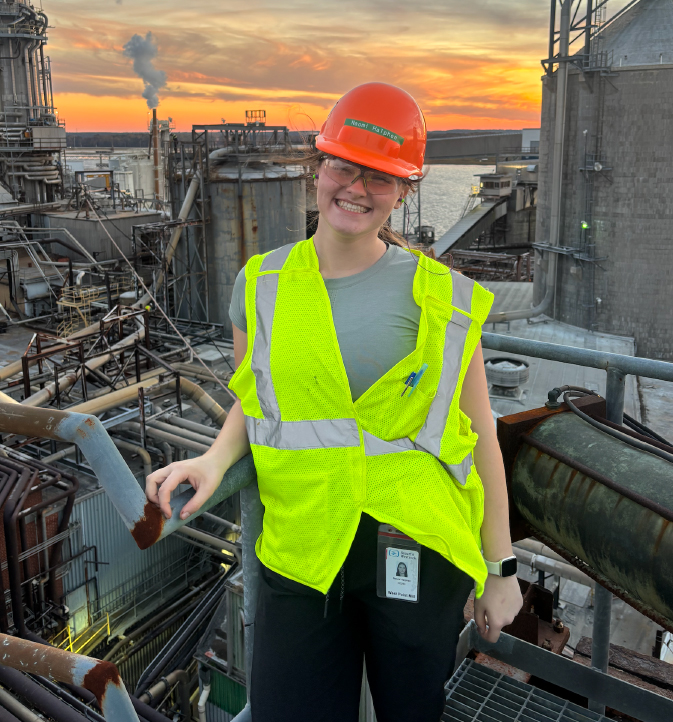
As mentioned earlier, in Fall of 2025, I had the opportunity to work at Smurfit WestRock paper mill in West Point, Virginia. I gained hands-on experience in a large manufacturing environment. During my time there, I worked on projects involving process improvement, safety, quality, and compliance, which allowed me to apply concepts from chemical engineering in a real industrial setting.
Some of the projects I worked on included leading internal ISO audit preparation for the co-op program, which supported the mill's successful recertification efforts, completing a Lean Six Sigma Yellow Belt process improvement project, and developing technical documentation such as an electrical power and receptacle map, as well as P&ID and one-line diagrams for the mill's fire water system. I also gained experience in paper testing, quality reporting, and collaborating across different departments with operators, engineers, and safety personnel.
One of the biggest lessons I took away from the experience was the importance of maintaining a strong safety culture in manufacturing. I learned the value of staying aware, avoiding complacency in routine tasks, and carefully planning work before beginning. The experience also taught me the importance of communication, initiative, and problem-solving in fast-paced environments.
Research with Dr. Luettgen at Georgia Tech
This past semester I pursued research with Dr. Luettgen at Georgia Tech. Our research group investigated the feasibility of using coated corn paper as tamale wrappings. We evaluated soy wax and carnauba wax coatings applied to corn paper using different Mayer rod sizes to study coating weight, consistency, and potential performance in food packaging applications.
Through this project, I gained experience with coating methods, experimental design, materials testing, and data analysis. We also explored how coating thickness impacts the behavior of the paper and identified future areas of study, including water retention and cohesion testing. I plan to continue this research throughout the summer and fall semesters.
What does this program mean to you?
This program has allowed me to connect my interests in chemical engineering, sustainability, and manufacturing in a meaningful way. It has also introduced me to a strong network of professionals, faculty, and students who are passionate about the industry. Through both coursework and research, I have been able to deepen my understanding of pulp and paper processes while gaining insight into the future of sustainable materials and packaging. I am confident that this program will set me up for success with my future endeavors post-graduation.
Where do you see yourself in five and 10 years, and what are your career aspirations?
In five years, I hope to be working in process engineering or manufacturing within the pulp and paper or sustainable materials industry, where I can contribute to process improvement, innovation, and sustainability initiatives.
In ten years, I would like to grow into a leadership role where I can help drive advancements in sustainable manufacturing and mentor future engineers entering the field.
What would you recommend to anyone who might be interested in getting into pulp and paper?
I would recommend being open to learning about the industry, even if it is not something you initially considered. There are so many opportunities within the pulp and paper industry, from manufacturing and process engineering to sustainability and research. Hands-on experience such as internships, co-ops, and research are especially valuable because they provide a much deeper understanding of the industry and its impact.
Please let us know of anything else of interest regarding your experiences in the program.
One of the most valuable parts of the program has been seeing how interdisciplinary the field is while also building close connections with faculty and other students. The industry combines engineering, sustainability, chemistry, manufacturing, and innovation in ways that directly impact everyday life. I have also appreciated the opportunity to engage in research while pursuing certification, which has allowed me to better understand both the academic and industrial sides of the field.
Please tell us your year in the program, your hometown, and anything interesting you do in your free time.
I am a rising Junior at Georgia Tech from Baltimore County, Maryland pursuing a B.S. in Chemical and Biomolecular Engineering, and this is my first year in the Pulp and Paper program. In my free time, I am involved with the Georgia Tech Figure Skating Club, and I also enjoy traveling and experiencing new places and cultures.