At the University of Minnesota, the Bioproducts and Biosystems Engineering (BBE) program prepares students to solve real-world problems with practical, sustainable solutions. It brings together biological sciences, engineering principles, and technology to address society's growing demands for material, food, and energy using renewable resources.
The BBE program enrolls about 120 undergraduate students, and more than half of them receive the departmental scholarship thanks to the generous support from industries, alumni and individual donors. About 75% of their students participate in research with faculty and ~80% complete at least one internship or co-op prior to their graduation. Their graduates have a very high job placement rate (>95%) in major food, energy, biobased materials, paper, and environmental consulting companies as well as environment-related government agencies.
Cameron Borner is a student in the program, and he shares some of his experiences at Minnesota.
What attracted you to the Bioproducts & Biosystems Engineering program?
I was drawn to the BBE program because sustainability was very clearly woven into the curriculum. I was originally pursuing a chemical engineering degree when applying to colleges, with the intention of working in sustainable packaging as a career. After learning about the program through the major exploration events, it just made sense to switch, that way my classes would be focused on methodologies that align with my core values instead of having to pursue additional emphasis classes to find that alignment. There was also the added benefit of the small size and close-knit community where I knew I would have more support in my classes, and while pursuing research and work opportunities.
Were you looking into pulp and paper when you were in high school?
I was looking into all aspects of sustainable packaging while in high school, mainly the more novel bioplastic sides of the field, but paper was always a strong option when thinking of future careers. Paper products have always been the sustainable option, and they stood out to me because there is a massive cultural acceptance compared to the newer bioplastics. So, as I progressed through my freshman and sophomore year of college, it became abundantly clear that the stability and versatility of the pulp and paper industry was more of what I wanted, especially once I had been introduced to the incredible papermaker community.
Tell us about the internships and/or co-ops you have had.
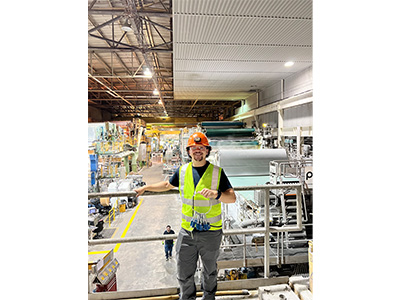
I only had one co-op during my undergraduate career, where I spent 15 months working in the Paper Technical Services department at the Sappi mill in Cloquet, MN. The experience I had was incredibly rewarding, as I was able to work essentially as a "real" full-time process engineer because of the longer duration. I earned my Green Belt certification in Lean Six Sigma, and was able to lead 2 separate improvement projects surrounding broke usage and lineal footage calculations. The projects that I worked on are still helping the mill reach water usage reduction goals, lowering variable cost and aligning yield goals. But aside from the engineering work, my favorite part of the experience was connecting with the people. I was able to build connections with operators, engineers and the surrounding community through day-to-day work and volunteering with the Sustainability Ambassadors team at the annual Carlton County Fair. Being able to explain to community members first hand how the forest products industry is enmeshed into their lives and hearing stories of generations spent in the field was something that I will always cherish.
What does this program mean to you?
The BBE program will always have a special place in my heart, and has become a second family to me. Coming to a university with more than 30,000 undergraduates, I was anticipating having a hard time finding my people, but after joining BBE all of those fears melted away. Everyone in the program has the shared sustainability mindset where we all want to help the world move in a better direction and do our best to help others, that shared mindset makes it really easy to connect. Our faculty, staff, alumni and students all share common goals, and often the same interests so it is really easy to build community and support each other. We also have the benefit of our smaller size, so we all get to know each other really well and often become close friends. So to summarize, BBE to me is about truly caring for one another, the planet and our future, and supporting each other so we can all find our unique versions of success.
Where do you see yourself in five and 10 years, and what are your career aspirations?
In five years, I hope to still be working at Sappi Cloquet as a process engineer and pursuing a graduate degree in coating and/or polymeric materials. In 10 years, I hope to be working specifically in the sustainable food packaging industry, whether that be as a process engineer, entrepreneur, or in management, time will really tell. I hope that the early years of my career set me up to further the paperization movement, and allow me to get plastic away from our food. They say that we, as Americans, currently consume about a credit card's worth of microplastics every week, and I don't want that to be something that my kids and the rest of the world have to worry about, so I will be striving to make that difference in the world.
What would you recommend to anyone who might be interested in getting into pulp and paper?
I would recommend anyone interested in entering the pulp and paper field to get involved with TAPPI early. Having the opportunity to attend both TAPPI Con and multiple Student Summits really opened my eyes to the variety of work going on in the field. Most people think about the basic products like printing papers, paper board, and sanitary products but rarely hear about the emerging technologies in the coating, thermoforming and waste valorization sectors. The conferences do a really good job of highlighting the vast research areas, and introducing young people to professionals that are open to establishing lifelong networking connections. The young professionals division also offers incredibly valuable resources on how "adulting" works, strategies to ease the transition from academia to industry, and a strong support network of people who are in the same boat as you are.
Please let us know of anything else of interest regarding your experiences in the program.
I would really like to highlight the variety of experiences available to the students within the BBE program. We are uniquely positioned because of our smaller size and deep connections with industry and government agencies to provide incredible research and work experiences. During my sophomore and junior years at the U, I was able to work under Professor Hu on a soil fungi inoculation project, and under Professor Ramaswamy with his membrane solvent extraction and paper drying decarbonization projects. Our faculty are exploring so many important and interesting projects within the agricultural, energy and bioproduct fields and providing industry with real solutions that will set society on the right path for a sustainable future, and they always have room for undergrads to get involved. We also have many luncheons a semester where companies like Sappi come and talk to our students directly, which makes finding internships and full-time jobs less stressful than going table to table at the large career fairs. Which is exactly how I got my co-op and now full-time job once I graduate in May.
Please tell us what year you are in the program, your hometown, and anything interesting you might do in your free time.
I am a senior on the Bioproducts track within BBE, graduating in May 2026! I grew up in Brooklyn Park, one of the largest cities in the northwest Minneapolis suburbs, but spent the majority of my time in the Plymouth area where I went to high school. The weather in MN really dictates what I do in my free time, so in the warmer months I like to get outside, camping, hiking, biking or fishing. While in the colder months, I spend the majority of my time playing board games, crocheting, woodworking or cooking with my girlfriend. In general, I really value using my free time to connect with my friends, family and nature.